




Table of Contents
- Outdoor Signs for Cold Climates in Saskatchewan: What Business Owners Need to Know
- Materials That Stand Up to Saskatchewan Winters
- Why Cold-Climate Signage Pays Off for Saskatchewan Businesses
- How Outdoor Signs Withstand Freezing Temperatures and Snow
- Installation and Maintenance Tips for Signs in Extreme Cold
- Choosing the Right Sign Partner for Saskatchewan Winters
Outdoor Signs for Cold Climates in Saskatchewan: What Business Owners Need to Know
When investing in outdoor signs for cold climates, Saskatchewan business owners must consider materials and construction that can endure freeze-thaw cycles, high winds, and intense UV exposure. At Signs Regina, we draw on 35 years of local experience to recommend solutions that last.
Aluminum composite panels offer a lightweight yet rigid substrate that resists warping and corrosion, making them ideal for outdoor signage in harsh prairie conditions. For illuminated signage, cold weather LED signs perform reliably in low temperatures without the warm-up lag common in older fluorescent systems. As the International Sign Association emphasizes, durable materials and proper engineering are essential for signs exposed to extreme weather.
Installation challenges in Saskatchewan include frost heave, which can shift sign foundations if not properly anchored. Our full-service team ensures that all exterior signs in Regina are mounted to stable footings and that every component, from structural posts to electrical connections, is built to code.
Permit and approval requirements vary by municipality — confirm with the City of Regina before installation. As a locally owned and operated sign company, we handle the entire process with attention to detail, from design through final inspection. Next, we’ll explore how to choose the right materials and design for your specific business needs.
Materials That Stand Up to Saskatchewan Winters
As we discussed in the previous section, Saskatchewan’s winter conditions are among the most demanding in Canada, and selecting the right outdoor signs for cold climates is critical for long-term performance. Materials that fail in extreme cold can warp, crack, or delaminate, leading to costly replacements and safety hazards. In this section we break down the materials proven to withstand Regina’s freeze-thaw cycles, heavy snow, and intense winter sun.
Aluminum Composite Panels: Industry Standard for Cold Climates
Aluminum composite panels—often referred to by the trade name Dibond—have become the go-to substrate for outdoor signage in cold regions. These panels consist of two thin aluminum sheets bonded to a solid polyethylene core, creating a rigid yet lightweight sheet that resists cracking even when temperatures plunge below -30°C. According to the sign industry association, aluminum composite panels are rated for cold climates and maintain their flatness through repeated thermal cycling. As a locally owned and operated sign and graphic company in Regina with 35 years of experience, we have seen firsthand how these panels hold their shape and finish season after season. They also provide a stable, durable base for cold weather LED signs, supporting the added weight of illumination without warping. CSA Group standards and Transportation Association of Canada specifications for signage durability reinforce the choice of aluminum composite for permanent outdoor applications.
PVC Versus Aluminum: Which Material Lasts Longer?
PVC (polyvinyl chloride) is a common, lower-cost substrate for signage, but its performance in extreme cold falls short of aluminum composite. When temperatures drop, PVC becomes brittle and prone to cracking, and repeated freeze-thaw cycles can cause warping that compromises the sign’s appearance and structural integrity. In Saskatchewan winters the comparison is clear:
| Feature | PVC Performance | Aluminum Composite Performance |
|---|---|---|
| Cold temperature performance | Can warp and crack | Stays rigid and stable |
| Impact resistance | Lower impact resistance | Withstands bumps and wind loads |
| Lifespan | 3-5 years | Exceeds 10 years |
| Recommended use | Small indoor or temporary | Large outdoor permanent |
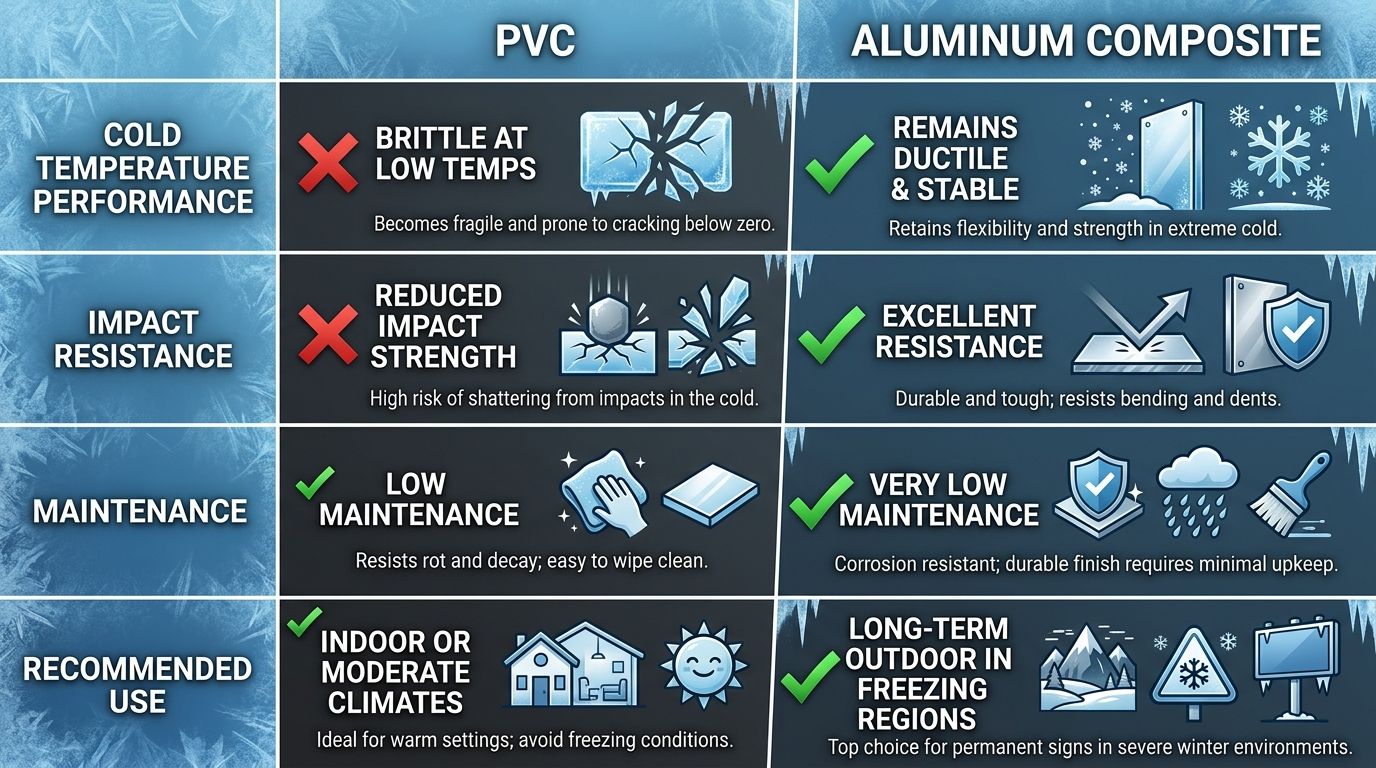
PVC vs aluminum composite panel comparison for cold-climate signage.
For any installation that must endure Saskatchewan’s severe winters, aluminum composite panels clearly outperform PVC in longevity and reliability.
The Role of UV-Laminated Vinyl and Coatings
UV-laminated vinyl and protective clear coatings play an essential role in extending the life of outdoor signs for cold climates by shielding graphics from ultraviolet radiation and moisture. In Saskatchewan, intense winter sunlight reflecting off snow can accelerate fading, while melting snow and freezing rain introduce moisture that can lift edges or degrade adhesives. We apply high-quality UV laminates that block harmful rays and maintain colour vibrancy for years. These coatings are tested against UL and CSA requirements for weather resistance, ensuring they prevent cracking and peeling even after repeated temperature swings. By combining aluminum composite panels with UV-laminated vinyl and protective topcoats, we create a sign system that withstands the full range of Saskatchewan weather.
Once the right materials are selected, the next step is ensuring the structural design—such as reinforced frames and cold-rated fastening methods—fully supports the sign against wind and snow loads. If you’re ready to discuss the best materials for your outdoor signage project, contact us for a free quote.
Why Cold-Climate Signage Pays Off for Saskatchewan Businesses
For businesses in Saskatchewan, investing in outdoor signs for cold climates is not a luxury — it’s a strategic decision that protects brand visibility through extreme winters. The right materials and technologies don’t just survive freeze-thaw cycles; they turn that durability into a measurable return on investment.
Rust-Proof and Weather-Resistant Signage Options
Saskatchewan winters introduce road salt, heavy moisture, and constant temperature swings that accelerate corrosion in ordinary materials. That’s why we build weather-resistant signage using aluminum composite panels and treated composites that naturally resist rust and structural fatigue. Aluminum does not oxidize the way steel does, and its lightweight strength stands up to winds that can reach 100 km/h. Our exterior signs product page emphasizes that these material choices directly extend the lifespan of a sign, sparing businesses from premature cracking, peeling, or warping that less durable alternatives suffer. Because we have 35 years of local experience, we understand which substrates survive repeated deep freezes and which ones fail — and we never recommend a material that can’t handle a Saskatchewan winter. By choosing rust-proof construction, businesses avoid frequent repairs and maintain a professional storefront year after year.
Energy Efficiency of LED Displays in Freezing Weather
One of the most overlooked benefits of cold-climate signage is how efficiently LED technology performs in low temperatures. Cold weather LED signs actually gain a thermal advantage: the ambient chill helps dissipate heat from the diodes more effectively, allowing them to run at lower internal temperatures while maintaining brightness. That translates to reduced electricity consumption and a longer operational life — our research confirms a minimum life expectancy of 25,000 hours. Our lighted signs in Regina leverage precisely this principle. The programmable LED displays we manufacture deliver crisp, visible messaging even during dark winter afternoons when sunlight fades before 5:00 PM. Because the cold doesn’t degrade the diodes, businesses get consistent illumination and lower energy bills compared to traditional fluorescent or neon alternatives, which often struggle with cold-start delays. For a Regina storefront, that efficiency means a sign that works harder while consuming less.
Long-Term Cost Savings Through Material Selection
Investing in cold-climate durable signage pays off in reduced lifecycle costs. When a sign resists rust, withstands wind, and uses efficient LED illumination, businesses avoid the continuous cycle of repairs and early replacements that eat into marketing budgets. Our 2026 commercial signage pricing comparison confirms that while quality materials may involve a higher upfront commitment, the long-term value is clear: fewer service calls, less frequent replacements, and uninterrupted brand presence. We handle the entire process from design to installation — including navigating municipal requirements — so elements like wind-rated mounting frames and corrosion-resistant fasteners are never overlooked. That attention to detail protects the investment and keeps the sign standing through decades of prairie weather. It’s important to note that permit requirements vary by municipality; businesses must confirm with the City of Regina before installation and ensure compliance to avoid penalties. Results may also vary; signage outcomes such as visibility and customer response are not guaranteed. The next section will explore how those durable installations translate into specific high-impact sign types, from channel letters to monument displays, each built for Saskatchewan conditions.
How Outdoor Signs Withstand Freezing Temperatures and Snow
We understand the demands that a Saskatchewan winter places on business signage. For companies investing in outdoor signs for cold climates, the engineering that goes unnoticed beneath the sign face is what keeps a brand visible when temperatures plummet and snow accumulates. Designing for this environment means moving beyond standard components to a system engineered for thermal resilience, moisture control, and structural stability.
How LED Signs Perform at -40 Degrees Celsius
The reliability of modern cold weather LED signs begins at the component level. The diode arrays within these displays are fully sealed, which prevents the direct contact between circuitry and moisture that causes standard electronics to fail. We use industrial-grade power supplies that are tested and certified for startup at temperatures as low as -40 degrees Celsius, ensuring the display illuminates consistently even during a deep freeze. This level of performance is supported by components that have undergone rigorous third-party testing; UL certification outdoor signage indicates that the electrical assembly has been evaluated against established safety and reliability benchmarks for extreme environments. These certified components eliminate the cold-start failures common in consumer-grade electronics, allowing a display in Regina to achieve full brightness without flickering or delayed illumination.
Preventing Condensation in Digital Signage Enclosures
The primary threat to an outdoor display in freezing weather is not the cold itself, but the moisture that results from temperature cycling. When warm air inside a sign cabinet meets a cold outer surface, condensation forms, leading to short circuits and frost damage on internal electronics. We eliminate this risk through a multi-stage environmental control strategy. Sign cabinets are constructed with high-quality gaskets that create a weather-resistant seal at every access point, while integrated drainage ports provide a managed exit path for any moisture that does penetrate the outer shell. Equally important are the breather vents installed on the cabinet, which equalize internal and external pressure without allowing water ingress. Drawing on standards established by the Transportation Association of Canada, which provides cold-climate infrastructure guidelines that inform our design practices, this approach to enclosure design ensures that sensitive LED drivers and power supplies remain dry and operational throughout the winter.
Why Thermal Expansion and Contraction Matter
A sign’s structural integrity is constantly tested by the extreme temperature swings common to Saskatchewan. Different materials expand and contract at dramatically different rates, a phenomenon known as thermal expansion. Without accommodating this movement, a sign face can warp or crack. We address this at the fabrication stage by selecting materials with compatible thermal behaviour. Aluminum composite panels, for example, provide a rigid yet dimensionally stable surface for printed graphics, while acrylic faces are mounted with flexible fastening systems that permit natural movement. Purpose-built gaps are engineered into the joints of the sign structure, absorbing the stress of expansion on a hot summer day and contraction during a January cold snap. This design philosophy—prioritizing material compatibility and flexible mounting—prevents the warping and cracking that would otherwise compromise the sign’s appearance and structural integrity. As a locally owned and operated sign and graphic company in Regina, we apply this technical understanding to every project, ensuring that businesses throughout the region have signage that endures season after season without failure.
Installation and Maintenance Tips for Signs in Extreme Cold
Saskatchewan winters demand a strategic approach to outdoor signs for cold climates—standard mounting and upkeep simply aren’t enough when temperatures plunge below -30°C. We bring over 35 years of local experience to every Regina project, ensuring that signage withstands freeze–thaw cycles, heavy snow loads, and biting winds. The right installation methods and a disciplined maintenance routine make the difference between a sign that fails mid–winter and one that performs flawlessly year–round.
Installation Techniques for Winter-Proof Signage
Successful outdoor signs for cold climates start with mounting techniques designed to handle thermal contraction. We select epoxy–anchored fasteners rated for concrete because they provide the gripping strength that expansion anchors lose in freezing temperatures. A 3 mm gap between the sign panel and the wall breaks thermal bridging, preventing frost from migrating into the building envelope and protecting both the structure and the sign’s electrical components. Our inventory of shop signs in Regina includes aluminum composite panels and cold weather LED signs that remain stable from -40°C to 40°C. We handle the entire process from design to installation, mounting signs on isolated standoffs so that ice buildup never forces the panel out of alignment.
Seasonal Maintenance Checks to Extend Sign Lifespan
A disciplined winter maintenance routine keeps outdoor signs for cold climates operating at full brightness. We recommend the following seasonal checks:
- Clear snow and ice from all sign faces and ventilation ports within 24 hours of a storm to prevent weight damage and condensation.
- Inspect perimeter seals and junction boxes for cracks; even hairline gaps allow moisture intrusion that leads to internal corrosion.
- Test LED brightness and verify that any built–in heating elements are functioning; dim or flickering modules in cold weather LED signs often signal an impending driver failure.
Our team’s attention to detail extends to digital displays. As our FAQ on outdoor screen reliability confirms, properly engineered panels with heated enclosures and IP65–rated weatherproofing operate reliably in freezing temperatures when maintained on a monthly schedule through the coldest months.
Working with Local Regulations and Permits in Saskatchewan
Bringing outdoor signs for cold climates to a Regina storefront requires more than solid engineering—it demands compliance with municipal bylaws. We manage the full permitting process, submitting applications through the City of Regina portal and coordinating with inspectors to ensure installations meet height, setback, and illumination requirements. Our familiarity with local regulations means we catch potential compliance issues before fabrication begins, saving you time and expense.
Permit and approval requirements vary by municipality — confirm with the City of Regina before installation. Permit processing and compliance are required; non–compliant signs may incur penalties (see City of Regina signage bylaws).
Professional installation, consistent seasonal care, and thorough permit management are the foundation of durable signage in Saskatchewan’s extreme climate. With our 35 years of local experience and a start–to–finish service model, we make the process seamless. Contact us today for a free quote and let us protect your investment against the elements.
Choosing the Right Sign Partner for Saskatchewan Winters
Saskatchewan’s winters demand outdoor signs for cold climates that can withstand extreme temperature swings, high winds, and heavy snow. Selecting the right sign partner is critical—you need a team that understands the unique challenges of our prairie environment. At Signco Graphic Supply, we bring 35 years of local experience to every project, ensuring your signage stays visible and reliable year-round.
When evaluating a sign partner, look for these essential criteria:
- Expertise in weather-resistant materials like aluminum composite panels and cold weather LED signs, which resist warping, fading, and moisture damage.
- Professional installation that accounts for freeze-thaw cycles and wind loading, keeping your signage secure and safe.
- Full-service capability—from design and permitting to manufacturing and installation—so you have a single point of accountability. We handle the entire process from design to installation.
- Compliance with local regulations, including City of Regina signage bylaws and industry benchmarks like the International Sign Association’s guidelines. Adhering to Canadian transportation signage standards is also a best practice for public-facing projects.
By choosing a partner with deep local knowledge and a commitment to quality, you invest in a long-lasting, cost-effective signage solution. Our team ensures every sign meets rigorous durability standards, giving you confidence through the harshest seasons.
Note: Permit processing and compliance are required; non-compliant signs may incur penalties (see City of Regina signage bylaws). Contact us for a free quote today.